

To select the suitable tint percentage for your car means to weigh up the factors of privacy, heat, and UV protection, visibility (especially at night), and keeping within the law. With this, you will know the meaning of the “car window tint percentage,” how to assess your requirements, and how to select the best tint level for your vehicle.
What does the term ‘car window tint percentage’ mean?
- The phrase is all about the film or glass Visible Light Transmission (VLT), i.e., the percentage of the external visible light that is allowed to penetrate the tinted window.
- For instance, a higher VLT percentage (say 70%) indicates that more light is permitted thus the tint is lighter. A lower percentage (for example, 15%) means that the tint is very dark and only a small amount of light can get through.
- Usually, when someone refers “20% tint”, they mean that the tinted film lets in around 20% of the visible light (and hence blocks ~80%).
- This number plays a crucial role in your tinted glass choice as it impacts visibility, comfort, look, and legality.
To better understand how different tint shades and materials affect performance, check out our detailed Ultimate Guide to Car Window Tinting
Purpose of the correct tint percentage
- Visibility & safety: If the tint is too dark, especially at night or in low-light conditions, you may lose clarity of vision.
- Heat & UV protection: One of the main reasons for tinting is to eliminate the heating of the car interior and at the same time provide protection from UV rays. How well a tint can accomplish this is dependent on the tint percentage (and also the film type).
- Privacy & aesthetics: Heavily tinted windows allow more privacy (people from outside can’t see in easily) and can make your car look trendier. Privacy, however, should not be at odds with visibility and legal limits.
- Legal compliance: With laws, for instance, there are restrictions on how dark you can allow the tints of certain windows to be (front windscreen, driver side windows) so that you do not hinder the visibility of yourself and others.
- Resale, comfort & other practicalities: A good tint enhances comfort (less glare, cooler cabin) and may improve resale if done properly.
Key factors to evaluate before choosing car window tint percentage:
You may want to think through the factors below before you decide on the right tint percentage for your car.
- Local regulations / legal limits: It is essential to check the VLT rules applicable to your area (country/state) for the front and rear windows as well as the windscreen. For instance, in India, side windows have to allow at least ~50% of visible light transmission.
- Usage & driving conditions:
In case you are predominantly a night driver, opting for a lighter tint (higher VLT) may be a better choice from the safety angle.
On the other hand, if you are driving in a hot and sunny place and want to get the maximum rejection of heat, then you might consider going for a darker tint (with lower VLT).
- What windows are being tinted: Frequently, front-side windows and the windscreen have lower limits than rear windows and rear windscreen.
- Material or type of tint film: The (dyed, metalised, ceramic) film type has an impact on heat/UV removal therefore, the darkness factor alone cannot be the performance indicator.
- Money & quality of work: The cost of good film with an expert installation is more but the performance, durability, and less possible problems (like bubbling, peeling) that can come out from the work will be better.
- Privacy & look vs light & view: Figure out how much privacy you need versus how much light/visibility you want to keep.
Recommended car window tint percentage ranges & how to interpret them?
We can understand the tint percentages (VLT) in a quite general way by having a look at each of them:
- ~70 % VLT: Extremely light tinted – the view through the glass is almost as without any tint, only a minimum of darkening. Useful if you want a very small effect on the appearance while getting some UV/heat protection as well.
- ~50% VLT: Moderate tint – darkening will be noticeable, a great deal of glare will be reduced and night visibility will remain good.
- ~35% VLT: Most balanced solution – a good combination of privacy, heat/glare reduction, and reasonable visibility.
- ~20-25% VLT: Dark tint – the privacy will be almost total and the heat/UV protection very strong, but the visibility will be limited and front windows may be regulated by legal restrictions.
- ~5-10% VLT: Extremely dark (commonly known as “limo tint”) – maximum privacy, very little light passing through, generally only allowed on the rear windows if at all.
How to decide the “right” percentage that suits you?
Here is a step-by-step decision guide:
- Firstly, find out the legal limits for your vehicle’s tinted windows in your area.
- Next, decide the windows that you are going to tint (front side, rear side, the rear windshield, the windscreen top strip).
- After that figure out your necessities: Do you want maximum privacy/heavy tinting or do you want good night visibility?
- Moreover, think about your climate and usage: In hot climates you may want films that reject heat more strongly; In cold or night-heavy use of the car type of situations, you may choose lighter ones.
- Then, Choose a film type. Either a budget (dyed) or a higher performance (ceramic) film, knowing that just by the darkness, the full story isn’t revealed.
- Next, Consider privacy vs safety/visibility. In case you decide on a dark tinted window (low VLT) make sure that under all driving conditions you still can see well.
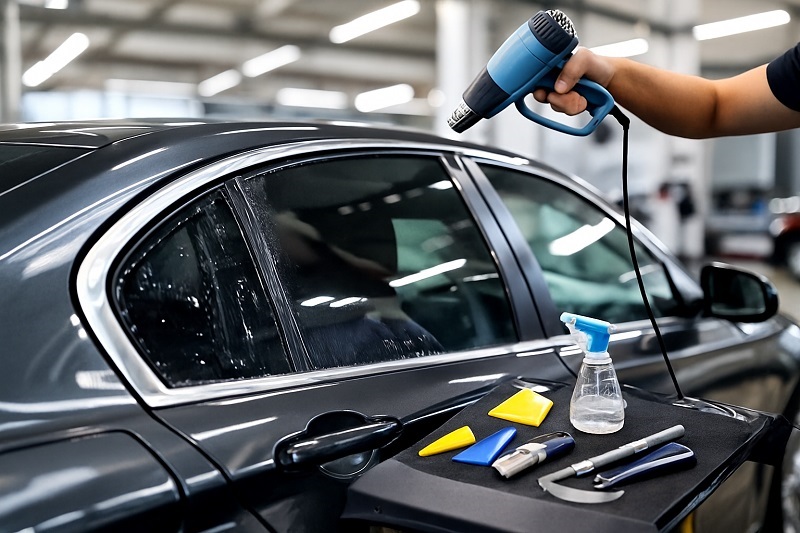
- Get an expert to do the installation. This is to prevent defects such as peeling, bubbling, or dust that is trapped. If you’re already seeing issues like peeling or bubbling, you may want to read our article on how to fix common car window tinting problems
- Follow the cleaning methods that are suggested so that the film remains in good condition.
Signs you picked the wrong tint percentage
- You have a hard time seeing at night or in dim light.
- You think that you are breaking the law or have been given a fine for illegal tinting.
- You suffer from the problems of glare/reflection and window film is peeling.
- The car interior still gets very hot (that might mean that the film is not performing or that it is a dark tint but a low-quality film).
Summary
The proper “car window tint percentage” is chosen by understanding what the number stands for (VLT), what your requirements (privacy, heat, visibility) are, what your local laws permit, and what kind of film you want. By going through your priorities and limitations, you will be able to select a tint that will bring you comfort, style, and legality instead of simply “as dark as I like”.
Frequently Asked Questions (FAQ)
People also ask these 10 questions about choosing car tint percentage. Let’s have a look at them:
The legality of car tint percentage depends on your location (state/country) and the window (front side, windscreen, rear) in question. Find out the local laws that set the minimum VLT (visible light transmission) allowed.
It tells the percentage of the light that is allowed to pass through the window (VLT). The lower the percentage, the darker the window will be.
Heat rejection in cars is mainly a matter of film (ceramic, metalised) rather than just the tint percentage. However, a moderate to low VLT (e.g., ~35%) with a good quality film is quite effective.
For a good level of privacy you can go for ~20-25% VLT or less, especially on the rear windows- but ensure that it is legal and that the visibility is still safe.
Absolutely. 35% has been a common choice that balances the pros and cons of the situation: decent privacy, glare and heat reduction, together with reasonable visibility.
A full front windshield tint at 5% would be against visibility/safety regulations in nearly all areas. Only a small top strip might be allowed at a low VLT.
Not really. Even though darker tints block more visible light and offer more privacy, the film material, reflector/infrared blocking capability, are what determine heat/UV protection, not VLT alone.
For night driving to be safe, it is better to have a moderate to high VLT (e.g., ~50% or more) so that you can maintain good visibility in dimly-lit conditions.
The professional technician will have a photometer or VLT meter to measure visible light transmission. You can definitely check with your technician before or after the job.
Yes. If you are beyond the legal limit of darkness for a particular window, the police can issue a traffic ticket to you and ask you to remove the tinted film. Always make sure you are compliant with the regulations.