
In the current competitive search environment, being ranked on Google is not just about obtaining backlinks or keyword density anymore. Google now rewards sites for showing expertise, authoritativeness, and trustworthiness for a particular topic, which is where topical authority plays a key role.
Are you wondering ways to develop topic authority? This is a step-by-step guide that explains a successful approach other top-ranking sites have adopted to ensure success in the U.S. online market.
What Is Topical Authority?
Topical authority refers to how well a website covers a subject in-depth and how strongly Google associates that website with the topic.
A site with strong topical authority:
- Included everything major under a subject
- Answers real user questions
- Offers relevance for a range of pages that correspond to different topics
- Uses smart internal linking and structuring
Such a site is viewed by Google as an authoritative source, hence easy to rank.
Why Topical Authority Matters for SEO in 2026?
The move is now coming to entity-based and semantic SEO in search engines. That means Google is now able to answer who should rank for a particular topic, rather than who has the most linkbacks.
Benefits of building topical authority include:
- Higher keyword rankings
- Faster indexing of new content
- Stronger visibility in AI Overviews
- Long-term organic traffic growth
- Reduced dependency on backlinks
For U.S. businesses and content publishers, building topical authority is now a core SEO strategy, not an optional one.
How to Build Topical Authority Step by Step?
1. Choose One Core Topic Not Multiple Niches
Your first step to establish topical authority should be to focus. Instead of writing about SEO, social media, paid ads, and web design, just to name a few, pick one central topic such as: local SEO, technical SEO, content marketing, e, commerce SEO.
Google favors specialization. Large and wide websites usually find it hard to gain topical relevance.
2. Conduct Topic, Based Keyword Research
At the core, traditional keyword research is all about volume. However, a topical authority strategy aims for thoroughness.
Accordingly, first, you have to determine:
- Main topic keywords
- Supporting topics
- Questions that people ask
- Long tail search queries
For instance, if you want to build topical authority, think about the following topics:
- What is topical authority
- Topical authority vs backlinks
- Content clusters
- Content silos
- Internal linking strategy
This is how you build a topical map,
3. Pillar Page Creation
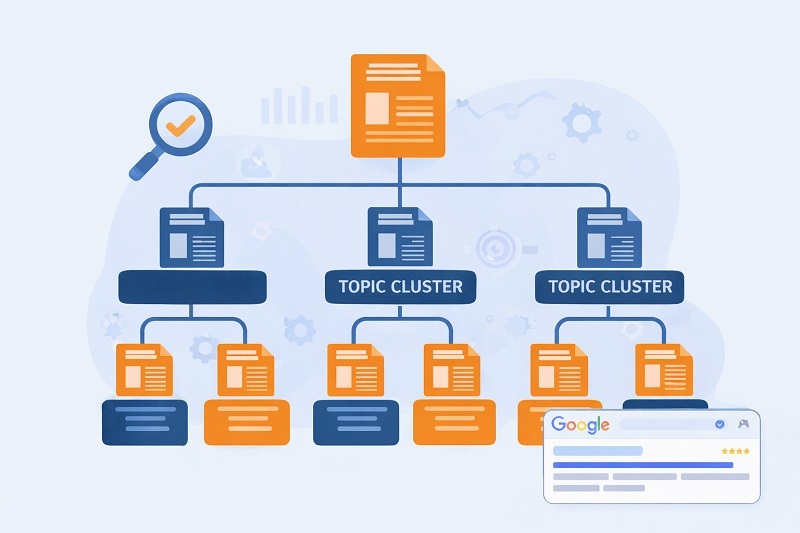
A pillar page is the centerpiece of your topical authority campaign.
A strong pillar page has:
- Targets main keyword, for example, how to build topical authority
- Covers the topic in general, yet clearly
- Links to detailed subtopic pages
- Serves as a hub within the middle
The pillar page is the overview; depth is handled by cluster pages.
4. Create Cluster Supporting Content
Cluster content explores the different branches of the main topic in detail.
Each piece needs to:
- Focus on a single question or subtopic
- Have internal links pointing to the pillar page
- Enhance topical relevance
- Not cannibalize keywords
This method shows Google that your site really understands the topic, which is a major factor in gaining topical authority.
5. Use Content Silos for Better Structure
Besides content silos, another very powerful way of gaining topical authority is through content silos.
The benefits of content silos:
- Relate agglomerating content together
- Make better crawlability
- Internal linking strengthening
- Topical relevance raising
Example silo structure:
- Pillar page Subtopic articles Supporting FAQs
If content silos are properly carried out, Google will be able to recognize the connections between different pages.
6. Optimize Internal Linking Strategically
Internal links also serve as importance signals.
Good habits:
- From cluster content, go back to the pillar page
- Use descriptive anchor text
- Don’t link randomly or excessively
- Links should be kept within the same topical silo
In this way, you will not only strengthen your topical authority strategy but also achieve better rankings throughout your site.
7. Maintain Consistent Publishing Within the Topic
Consistency is essential.
Publishing 20 articles on one topic will do more for a site than publishing 20 articles on 20 different topics.
To keep your topical relevance:
- Update older content
- Extend current content clusters
- Add new sections such as FAQs and comparisons
- Update statistics for the American market
- Consistency over time are great trust signals.
8. Show E, E, A, T (Experience, Expertise, Authority, Trust)
Google assesses the authority of the source.
Some good ways to raise E, E, A, T are:
- Include author biographies
- Reference credible U.S. sources
- Give real, life examples
- Offer new insights
These 4 steps enhances topical authority the fastest and gets you more visibility in AI searches.
Common Mistakes That Hurt Topical Authority
Avoid these issues:
- Publishing unrelated content
- Thin or repetitive articles
- Weak internal linking
- Ignoring content silos
- Chasing keyword volume over topical relevance
Topical authority is built through depth, structure, and intent, not shortcuts.
How Long Does It Take to Build Topical Authority?
For most U.S. websites:
- Small niches: 3–6 months
- Competitive niches: 6–12 months
- Authority brands: ongoing growth
Results depend on content quality, competition, and consistency.
Frequently Asked Questions (FAQs)
Below are 10 common FAQs, ordered from most searched to least searched, written exactly how users type them into Google or AI search tools.
Topical authority in SEO means a website is recognized by Google as a trusted expert on a specific subject due to in-depth, well-structured content.
You build topical authority by focusing on one topic, creating pillar and cluster content, using content silos, and maintaining strong internal linking.
Yes, topical authority helps improve rankings by increasing trust, relevance, and visibility across multiple related keywords.
Topical authority focuses on content depth and relevance, while backlinks signal trust. In modern SEO, topical authority often drives rankings even with fewer links.
It usually takes 3 to 12 months to build topical authority, depending on competition, content quality, and publishing consistency.
Content silos are a structured way of grouping related pages to improve topical relevance, internal linking, and search visibility.
Most websites need 10–30 high-quality articles within one topic to start building noticeable topical authority.
Yes, Google uses topical authority concepts through semantic search, entities, and E-E-A-T to evaluate content quality.
Yes, small websites can build topical authority faster by focusing on narrow niches and publishing highly targeted content.
A topical authority strategy is a content plan that focuses on covering a topic completely using pillar pages, clusters, and content silos.
Final Thoughts
Learning how to build topical authority is no longer optional for SEO success—especially in AI-driven search environments. By focusing on structure, depth, and topical relevance, you can create long-term rankings that outperform backlink-heavy competitors.