
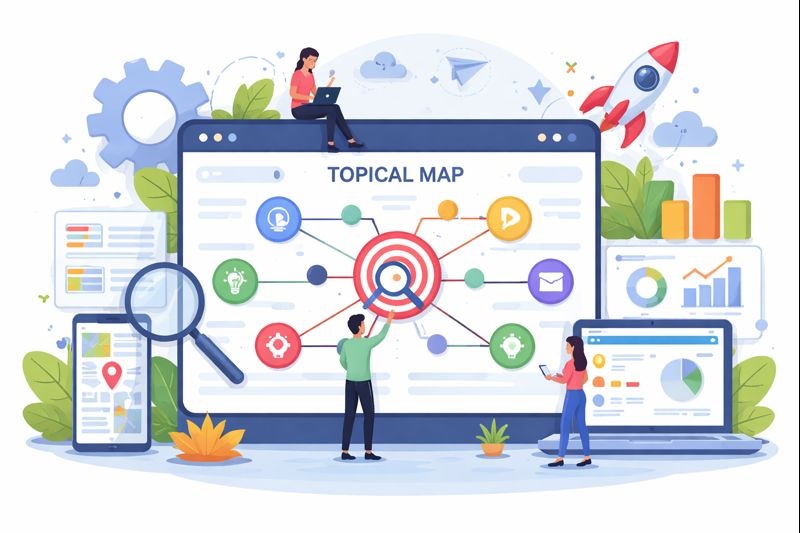
Search engines have come a long way from just sorting out single words. Today, Google focuses on topical relevance, depth of content, and topic authority. This is where a Topical Map in SEO is crucial.
A topic map is like a roadmap for organizing stuff so search engines can get what you’re talking about Instead of just throwing together random blog posts, you create a well-organized content system that shows you’re knowledgeable, reliable, and an authority.
This guide breaks down what is topical map in SEO, why it matters, how it functions, and walks you through making one, step by step.
What is Topical Map in SEO?
A topical map in SEO is like a roadmap for content, where you organize the main topic and subtopics, questions, and supporting ideas.
It shows:
- What content to create
- How should pages be linked internally?
- How are topics related to each other semantically.
In simpler words, a topological map is like a guide from establishing topological control.
Instead of just hunting for single words, you dive deep into teh whole subject.
Why is a Topological Map Important for Today’s Seo?
Topological Map Important for Today’s Seo because Google’s algorithms prioritize:
- Depth of topic on keyword repetition
- Semantic relations
- Content completeness
A strong topological map helps you in SEO:
- Rank for multiple related keywords
- Improve crawl efficiency
- strengthen internal connections
- Win Featured Snippets and AI Overview
- Build long term authority
This method is right on track with Google’s Accessibility Content System and E-E-A-T guidelines
How Does a Topological Map Work?
A topological map is made up of three key layers:
1. Main topic (Column page):
This is the primary subject you’re aiming to rank.
For Example: Topical Maps in SEO
2. Subtopics (cluster pages):
These cover various aspects of the main subject.
Example:
- How do topological maps work?
- Topical Map vs. Keyword
- Benefits of topical mapping
3. Supporting Content
These answer specific questions and long-tail searches.
Examples:
- How many pages should a topical map have?
- Is topical mapping good for new websites?
Each page connects to other pages in a way that makes sense, forming a network of related content.
Topical Map vs Traditional Keyword Research
| Traditional Keyword Research | Topical Map in SEO |
|---|---|
| Focuses on single keywords | Focuses on entire topics |
| Often leads to thin content | Encourages deep coverage |
| Keyword competition driven | Intent & relevance driven |
| Short-term rankings | Long-term authority |
Keyword research is still a big deal, but mapping out topics is more than just finding keywords; it’s about linking up what people really mean and what they’re aiming to find
How to Create a Topical Map in SEO (Step-by-Step)?
Step 1: Choose One Core Topic
Pick a core topic that:
- Matches your niche
- Has informational depth
- Supports multiple subtopics
Step 2: Identify Subtopics and Entities
Look for:
- People Also Ask questions
- Related searches
- Competitor content gaps
- Semantic entities
Step 3: Group Keywords by Intent
Organize keywords into:
- Informational
- Comparative
- Transactional (if applicable)
Step 4: Plan Content Hierarchy
Decide:
- Pillar page
- Supporting articles
FAQ-based pages
Step 5: Build Strong Internal Links
Every page should:
- Link to the pillar page
- Link to closely related subtopics
If you’re looking to really get into the nitty-gritty of building authority, check out this comprehensive guide on How to Build Topical Authority
Common Mistakes to Avoid in Topical Mapping
- Creating too many pages without internal links
- Covering unrelated subtopics
- Ignoring search intent
- Publishing content out of sequence
- Treating topical maps as one-time tasks
Topical mapping is an ongoing strategy, not a checklist.
10 Most Searched FAQs About Topical Map in SEO
A topical map in SEO is a structured content plan that organizes a main topic and its related subtopics to build topical authority and improve search rankings.
A topical map helps SEO by improving relevance, internal linking, crawlability, and by signaling expertise to search engines.
Topical mapping is not a replacement but an upgrade—it uses keyword research while focusing on topic depth and user intent.
You create a topical map by choosing a core topic, identifying subtopics, grouping keywords by intent, and planning internal links.
There is no fixed number; it depends on the topic’s complexity and how many meaningful subtopics exist.
Yes, topical maps are especially effective for new websites because they help establish authority faster.
Common tools include Google Search, Ahrefs, SEMrush, Screaming Frog, and entity-based research tools.
A topical map is the structure; topical authority in seo is the result achieved by executing that structure properly.
They often lead to more stable and long-term ranking improvements rather than quick but temporary gains.
Yes, topical maps improve visibility in AI overviews by providing structured, comprehensive, and answer-focused content.
Final Thoughts
A topical map in SEO is no longer optional—it’s a foundational strategy for ranking in modern search engines. By organizing content around topics instead of isolated keywords, you create clarity for users and confidence for search engines.
If your goal is long-term rankings, authority, and visibility in AI-driven search, topical mapping is the path forward.